
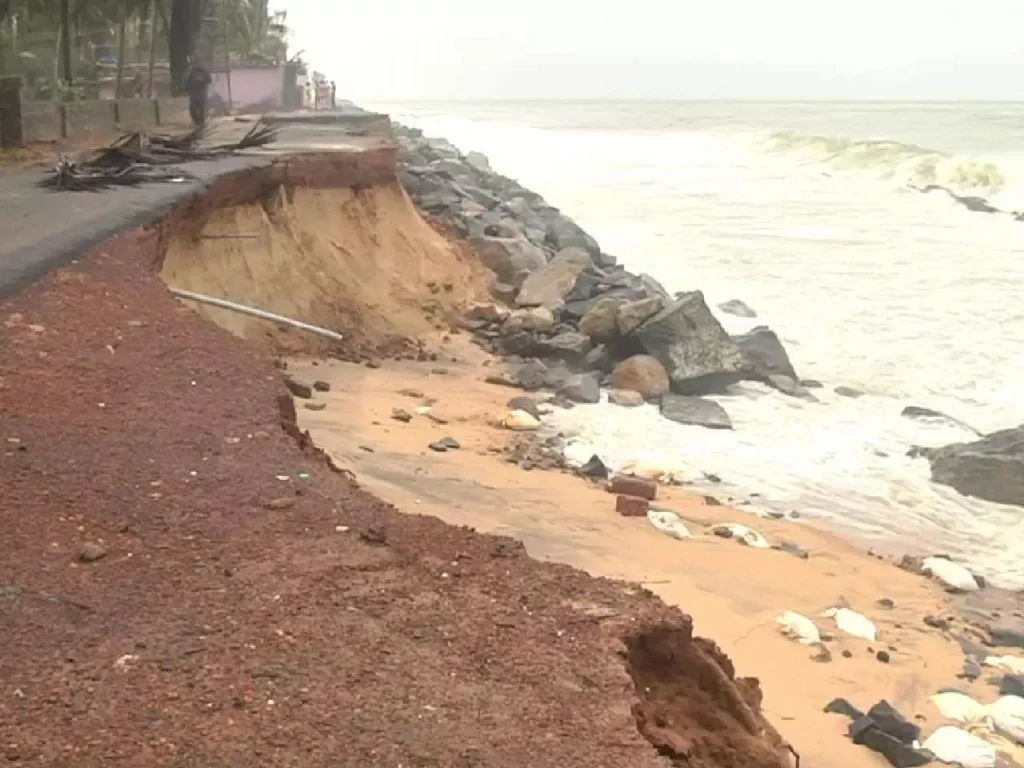
India’s coastline is one of its most defining features. It’s a vibrant zone of trade, culture, and life for millions, and yet, this frontier is shrinking. Coastal erosion in India has rapidly accelerated, becoming a national crisis that threatens not just beaches, but entire ways of life.
As per a study by the National Centre for Coastal Research (NCCR), the east coast, which has a total length of about 3,145 km, has seen roughly 38% of its shoreline erode. This just goes to show that the Indian coastline erosion rate is alarmingly high here. The erosion of the east coast of India is relentless, driven by aggressive waves, frequent storm surges, and the obvious reality of rising sea levels. When the land washes away, it directly impacts coastal villages, damages crucial infrastructure like roads and ports, and spoils valuable farmlands.
For years, the standard solution has been to fight the ocean with hard, rigid structures, right?. But here lies the problem. These often fail. The soft, uneven coastal soil cannot support heavy concrete and stone. It’s just a costly, recurring battle. And, this is precisely why Signet EnerTech brings in innovative solutions like Geotextile Tubes. These are modern, flexible, high-strength barriers designed to work with the dynamics of the coast. To secure our future, India desperately needs better, long-lasting, climate-resilient shoreline protection techniques.
Why the East Coast Is Eroding Faster
Why is the eastern shore suffering more than its western counterpart? The answer lies in a tough combination of natural hostility and human activity.
The causes of coastal erosion in India are complex, but the East Coast has several natural disadvantages. First, the Bay of Bengal is simply a tougher, more volatile neighbour than the Arabian Sea. It’s a breeding ground for storms, which just means more intense waves and more frequent tropical cyclones. Every major cyclone-induced erosion event strips away massive amounts of sand, often in a single night. What’s more, rising sea levels and erosion are magnified here because the coast is generally low-lying and flat, allowing storm surges to penetrate further inland.
Then there is the human factor. When we construct ports or expand harbours, we often interfere with the natural flow of sand (littoral drift) along the shore. The worst culprit, however, is the sediment imbalance. Major rivers that empty into the Bay of Bengal are now heavily dammed upstream. These dams trap sand and silt, starving the coastline of the sediment it naturally relies on to rebuild itself. The ocean keeps taking, but the rivers no longer supply the material needed for replenishment. The result is chronic, fast-paced land loss.
Impact on Communities and Essential Infrastructure
The impact of coastal erosion is felt most acutely by people. This isn’t just a geographical problem; it’s a humanitarian and economic disaster. For coastal families and fishermen, a disappearing shoreline means shoreline loss of their home, their working space, and their traditional fishing grounds. We are witnessing rapid community displacement as the sea forces people to abandon ancestral villages.
Economically, the threat to coastal infrastructure risk is immense. Critical coastal highways and transport embankments are constantly undermined by wave action. You frequently hear stories of roads collapsing after heavy rains and waves compromise their foundations. The encroachment of saltwater also ruins agricultural fields, making them saline and unusable.
The cost of repairing damaged public property and continually strengthening embankments is skyrocketing, creating a painful cycle of destruction and rebuilding. To break this cycle, we need to stop relying on temporary fixes. We must adopt smarter, climate-resilient coastal design that can protect people, assets, and the economic future of these states.
Why Traditional Protection Methods Fail
For generations, the default response to a receding shoreline has been “build a stronger wall.” We’ve seen massive seawalls, huge stone groynes, and complicated tetrapods deployed across the coast. Unfortunately, experience shows that these shoreline protection systems are fighting a losing battle.
The core flaw is rigidity. The ocean is a force of constant, dynamic motion, but structures like concrete and heavy rock cannot adjust. They are placed on soft, unpredictable coastal soil and tend to shift, settle, or sink over time.
Worse still, heavy waves crashing into a vertical, rigid structure reflect their energy downwards, scouring the sand right from the base. This process is called toe scour, and it quickly undermines the foundation, causing the structure to crack and fail spectacularly. Hard coastal engineering limitations are becoming impossible to ignore as storm intensities increase. We need a system that adapts to the shifting seabed and absorbs wave energy instead of aggressively rejecting it. This recognition is why erosion control challenges are now being met with flexible, modern alternatives like geotextile tubes.
How Modern Solutions Like Geotextile Tubes Help
To overcome the challenges of hard, rigid construction, engineers worldwide are increasingly implementing geotextile coastal protection. At Signet EnerTech, we deliver the global best practice through advanced SoilTain Geotextile Tubes.
These are essentially high-tech fabric sleeves: large-format containers made of incredibly high-strength, abrasion-resistant geotextile fabric. They are installed parallel to the coast and filled using local sand or dredged materials. Once filled, they act as stable, yet flexible, revetments.
Here is why these erosion control solutions are a breakthrough:
- Flexibility and Absorption: The tubes absorb wave energy instead of reflecting it. Because they are flexible, they can tolerate minor movement and settlement in soft soil without cracking or breaking, unlike concrete.
- Cost and Logistics: They utilise locally available sand as the filler material. This eliminates the massive logistical and environmental headache of trucking in thousands of tons of heavy stone, making the solution highly cost-effective and sustainable.
- The Scour Protection System: A major innovation is the inclusion of a scour protection mat. Made of a ribbon cloth and anchor tubes, this essential component is installed beneath the main barrier. It prevents waves from digging out the sand from under the tube, guaranteeing positional stability and preventing undermining.
- Environmental Integration: The specially developed fabric cover blends with the natural environment. Underwater, the surface quickly allows maritime flora and fauna to colonize the structure, meaning these are not dead barriers but a genuine part of the ecological system.
These Geotextile Tubes are used for creating breakwaters, groynes, seawalls, and comprehensive revetment system applications globally. This is truly the future of geosynthetic erosion control.
Realistic Applications on India’s East Coast
The potential for deploying geotextile tubes along the East Coast is transformative. These adaptable systems can be strategically used across critical locations.
- Eroding Beaches: They can be buried under a thin layer of sand to create an invisible core that prevents the underlying soil from washing away, thereby restoring the beach profile and offering long-term shoreline stabilization.
- Protecting Ports and Highways: Geotextile tubes are perfect for safeguarding ports, harbours, and essential coastal highways from constant wave impact. They stabilize weak coastlines much more effectively than rigid rock walls.
- Delta Regions: In the challenging river mouths and deltas, where the soil is often extremely weak, the distributed load of the tubes is far superior to heavy stone.
By choosing these coastal protection methods in India, we are securing crucial land and infrastructure against the threat of east coast erosion India. This is a proactive step toward sustainable coastal management.
Why This Matters for India’s Future
India’s exposure to natural calamities is only going to intensify. Stronger storm surges and more extreme weather are already guaranteed realities of climate change. With a large and growing population concentrated in coastal zones, the need for climate-resilient infrastructure is not optional; it is mandatory.
The future of coastal protection in India depends on our willingness to adopt adaptive, sustainable solutions. Geotextile systems are exactly that: flexible, quick to install, cost-effective, and designed for the long haul. They offer true sustainable shoreline protection by working with the environment.
We are past the point of simple repairs. If we fail to protect our coast with modern, resilient systems now, the loss of land, property, and lives will continue to escalate rapidly. Choosing innovative, proven methods is how we secure our shorelines for the next century.
Conclusion
The threat of coastal erosion in India, especially along the East Coast, demands immediate and smart action. The limitations of rigid, traditional methods are clear. Signet EnerTech is proud to deliver the solution: high-strength geotextile tubes. These systems offer strong, flexible, and environmentally responsible protection. It is time for India to commit to building climate-resilient coastlines, safeguarding our people, and securing our invaluable land.
As experts in geo-technical and cutting-edge technological solutions, Signet EnerTech is ready to partner with you to achieve long-term coastal stability. Contact us today for a consultation on your next shoreline protection project.
signet.co.in