
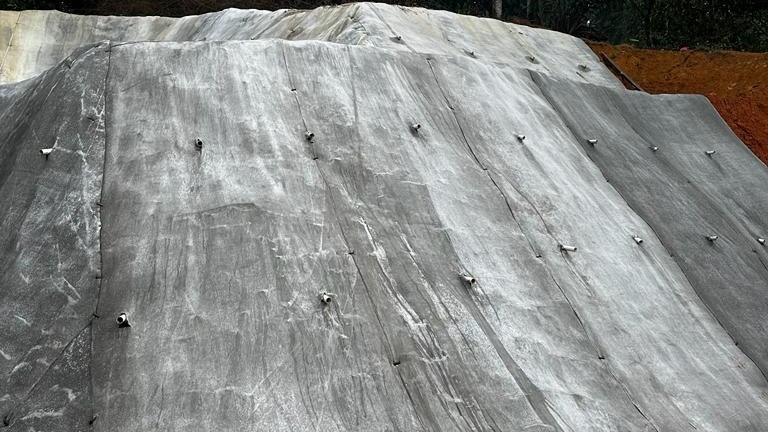
For decades, the standard response to erosion, slope instability, or canal leakage has been the same: pour more concrete. While traditional concrete is undoubtedly strong, it comes with a heavy logistical burden. It requires massive amounts of water, heavy machinery, specialized formwork, and significant time for curing. In remote or environmentally sensitive areas, these requirements often turn a simple protective project into a logistical nightmare. Furthermore, traditional concrete is rigid; as the ground shifts or settles, it often cracks, leading to costly repairs and compromised environmental protection.
This is where the concrete carpet (also known as Cementitious Composite Geosynthetic Carpet, or CCGC) offers a transformative shift. It is a modern environmental protection concrete solution that addresses the inherent limitations of poured concrete. By combining the strength of stone with the flexibility of fabric, it provides a way to “clothe” the landscape in a protective, durable shell. In this article, we will explore why this geosynthetic innovation is becoming the preferred choice for engineers looking for speed, durability, and a reduced environmental footprint.
What Is Concrete Carpet?
At its simplest, a concrete carpet is concrete on a roll. It is a pre-manufactured fabric system filled with a specialized dry concrete mix. Unlike traditional methods where concrete is mixed and poured on-site, this material arrives ready to be deployed. It essentially functions as a flexible concrete mat that can be draped over almost any surface, regardless of its complexity or shape.
The technology behind Signet’s CCGC represents a combination between geotechnical engineering and traditional masonry. It is classified as a geosynthetic solution because it relies on high-strength textiles to provide the structural framework that holds the cementitious material in place. This design ensures that the concrete remains exactly where it is needed, preventing the displacement or “slumping” that often occurs when trying to pour wet concrete on steep slopes.
Conceptually, it differs from traditional concrete in how it handles tension. Standard concrete is excellent under compression but weak under tension, which is why it requires steel rebar. A concrete carpet uses thousands of embedded fibers within its geotextile layers to provide internal reinforcement. This allows the material to remain thin and lightweight while maintaining a high level of structural integrity.
How Concrete Carpet Works
The efficiency of this rapid concrete installation solution lies in its unique composition and the way it transitions from a flexible fabric to a hard protective layer.
The Layered Composition
Signet’s CCGC is a needle-punched composite consisting of several critical layers:
- Upper Geotextile Layer: A durable fabric that allows water to permeate for hydration while protecting the dry mix during transport.
- Cement-Sand Mix: A dry, specialized mixture optimized for high strength and durability.
- Lower Geotextile Layer: Works in tandem with the upper layer to lock the mix in place.
- Needle-Punching Process: Long needles pull fibers from the upper geotextile through the cement mix and into the lower layer, mechanically bonding the entire system together so the concrete cannot shift.
- Geomembrane Backing: For projects requiring complete waterproofing, like canal lining, an additional layer of geomembrane can be added to the bottom to ensure zero permeability.
Deployment and Curing
Because it is supplied in roll or mat form, the installation is straightforward. The rolls are laid out and cut to fit the specific area. Once in place, the concrete-filled geotextile is hydrated, usually by spraying it with water.
Unlike traditional concrete, which can take weeks to reach full strength and requires careful monitoring, CCGC begins to harden just a few hours after hydration. Even after hardening, it remains fractionally flexible. This uniqueness allows the material to absorb minor ground movements without the cracking seen in rigid slabs.
Concrete Carpet vs Traditional Concrete
When evaluating concrete carpet vs traditional concrete, the differences in logistics and long-term performance are stark. Traditional concrete is a “wet” process that requires precise site conditions, whereas CCGC is a “dry” installation that only becomes wet at the very end.
Key Comparisons:
- Installation Speed: CCGC is up to 10 times faster than traditional concrete work.
- Equipment Needs: Traditional concrete requires batching plants, mixers, pumps, formwork, and heavy transport vehicles.CCGC installation requires only light equipment such as hand tools, anchoring systems, and a water source for hydration; a small crane or excavator may be used for handling large rolls on site.
- Labor Requirement: CCGC requires significantly fewer people on-site, in comparison to traditional concrete projects.
- Terrain Adaptability: Traditional concrete is difficult to pour on steep or uneven ground. Furthermore, traditional methods add significant dead weight to a structure, which can actually compromise the stability of a delicate incline. In contrast, CCGC is highly flexible and conforms to any shape. Its lightweight nature makes it the ideal choice for slope protection on gradients even up to 75 degrees, providing robust armor without the structural burden of heavy, poured concrete.
The most significant advantage in environmental projects is the ability to install CCGC in rain or even underwater, where pouring traditional concrete would be impossible or would result in significant washout.
Concrete Carpet Applications
Because of its versatility, concrete carpet applications span across various sectors, from civil infrastructure to heavy industry and defense.
Concrete Carpet for Erosion Control
Soil erosion is a silent threat to infrastructure. Whether it is a drainage channel or a river bank, moving water eventually strips away the soil, leading to structural failure. Using concrete carpet for erosion control provides a hard armor that water cannot penetrate.
- Channel Lining: It provides a smooth, high-velocity surface that prevents vegetation growth and soil washout.
- Bank Protection: It can be used to protect the banks of rivers or reservoirs from wave action and varying water levels.
- Drainage and Ditches: It is ideal for recovering road ditches and nozzles, ensuring that water is directed safely away from roadbeds.
Concrete Carpet for Slope Protection
One of the most challenging tasks in civil engineering is stabilizing steep, irregular slopes. Concrete carpet for slope protection is effective because it does not require the heavy equipment that would typically struggle to navigate a steep incline.
- Surface Stabilization: It acts as a protective skin, preventing landslides caused by surface water infiltration.
- Adaptability: Unlike rigid concrete panels, CCGC can follow the natural contours of a rocky or uneven hillside, ensuring there are no gaps where water could gather.
- Landslide Mitigation: By sealing the surface, it keeps the substrate stable during heavy monsoon rains.
Concrete Carpet as a Lining Solution
As a concrete carpet lining solution, CCGC is highly efficient for containment.
- Canals and Pits: It is used extensively for lining irrigation canals, where preventing water seepage is critical for agricultural efficiency.
- Environmental Containment: It is perfect for lining secondary containment areas to prevent chemical or fuel spills from reaching the soil.
Key Advantages of Concrete Carpet in Environmental Projects
Choosing an environmental protection concrete solution involves more than just looking at the final strength. It involves looking at the total lifecycle of the project.
- Extreme Installation Speed: Projects that would take weeks with traditional concrete can be finished in days.
- Reduced Environmental Disturbance: Because CCGC is delivered in rolls, it requires significantly fewer truck movements. This is vital in sensitive ecosystems.
- Sustainability: CCGC limits the thickness of concrete required to achieve the same protective results as a much thicker poured slab. A key advantage here is the guaranteed uniform thickness; while traditional pouring methods often result in uneven distribution, especially on rugged terrain, CCGC provides a consistent, factory-controlled profile across the entire surface. This eliminates weak points and ensures that the material performs exactly as engineered, without the need for over-pouring.
- No Material Wastage: In traditional concrete work, over-ordering is common. With CCGC, the cement is already contained within the product; you only use what you lay down.
- Long-Term Durability: With a lifespan exceeding 50 years and resistance to UV rays, it is a solution that requires minimal maintenance.
When Is Concrete Carpet the Right Choice?
While traditional concrete still has its place in heavy structural foundations, concrete carpet applications are the superior choice in several specific scenarios:
- Remote Locations: When the site is miles away from the nearest batching plant, transporting dry rolls is far more practical.
- Time-Sensitive Installations: For emergency repairs to a breached canal or a failing slope after a storm, CCGC offers a rapid-response solution that prevents further damage. This speed significantly lowers overhead costs by reducing the need for heavy machinery rentals, long-term site security, and extended labor shifts compared to traditional masonry.
- Sites with Limited Access: If you cannot get a concrete pump or a mixer truck to the area, CCGC can be manually carried or lowered into place.
- Projects where flexibility is critical: For lining curved culverts, circular pits, or irregular rock faces, the flexibility of the fabric before it hardens is a major engineering advantage.
Conclusion
The concrete carpet is more than just a convenient alternative; it is a fundamental shift in how we approach environmental and geotechnical challenges. By moving away from the “brute force” method of pouring thick slabs and toward the use of an engineered geosynthetic cementitious composite, we can protect our landscapes more efficiently and sustainably.
Whether it is protecting a critical pipeline, lining a canal, or stabilizing a slope, Signet’s CCGC has proven that modern infrastructure does not have to come at the cost of environmental health. As we look toward a future where speed, flexibility, and sustainability are paramount, the flexible concrete mat stands out as a smart, durable, and reliable engineering choice.
For more information on Signet CCGC, contact our team and we’ll help you find the perfect fit for your project. https://signet.co.in/contact-us/
FAQ
1. What is a concrete carpet (CCGC)?
A concrete carpet, also known as Cementitious Composite Geosynthetic Carpet (CCGC), is a pre-manufactured fabric filled with dry concrete that hardens after hydration, forming a durable and flexible concrete layer.
2. How is concrete carpet different from traditional poured concrete?
Unlike poured concrete, concrete carpet is supplied in rolls, installs quickly without heavy machinery or formwork, and remains slightly flexible after curing, reducing cracking due to ground movement.
3. Where is concrete carpet commonly used?
Concrete carpet is widely used for erosion control, slope protection, canal lining, drainage channels, containment areas, and surface stabilization in difficult or remote locations.
4. Is concrete carpet suitable for environmentally sensitive areas?
Yes. It requires less water, fewer truck movements, minimal site disturbance, and produces no material wastage, making it ideal for environmentally sensitive or hard-to-access sites.