
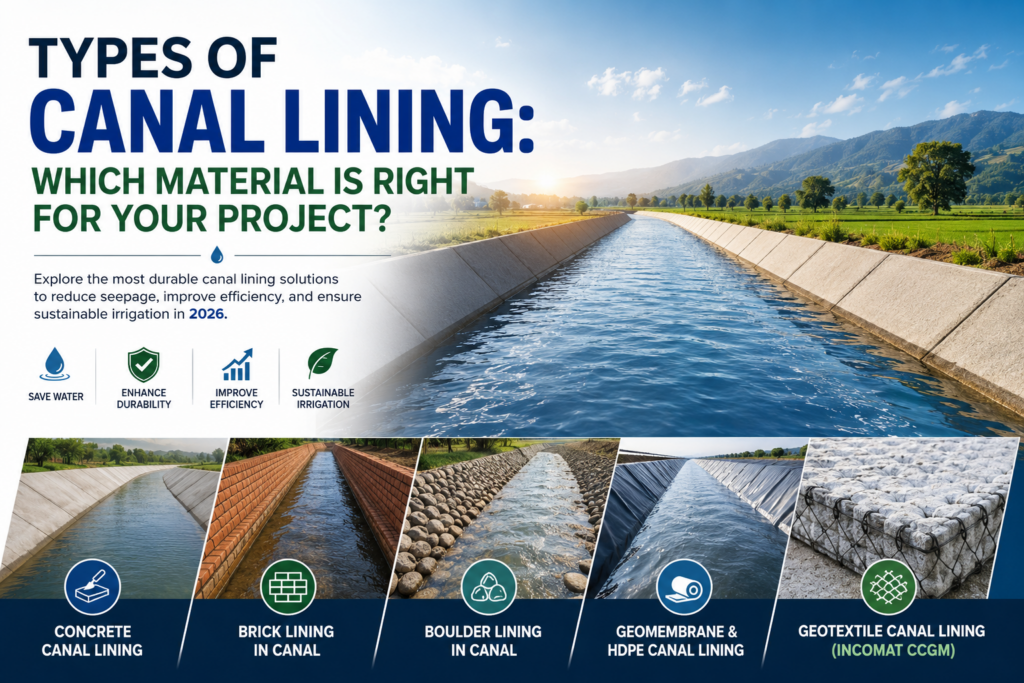
Unlined canals in India lose up to 60% of water to seepage. This guide explores the most durable canal lining solutions to ensure sustainable irrigation in 2026.
Unlined irrigation canals across India lose between 25% and 60% of their water to seepage before it ever reaches a farm. With water scarcity hitting record levels in 2026, the shift toward impermeable lining isn’t just an upgrade, it’s the only way to meet the Jal Shakti mission’s conservation mandates.
The scale of this water loss is staggering when you consider that agriculture accounts for the vast majority of India’s water consumption. When more than half of that water disappears into the soil through porous canal beds, the efficiency of our entire irrigation network collapses. We are no longer in an era where we can afford such waste. To ensure sustainable irrigation for the next generation, we must transition to advanced canal lining materials that offer zero seepage and multi-decade durability.
What is canal lining?
Canal lining is the application of a protective layer to the bed and sides of a canal to prevent water loss through seepage and improve the flow capacity of the irrigation system. Think of it as creating an impermeable sleeve for the water to travel through.
By sealing the channel, canal lining reduces hydraulic roughness. This allows water to move faster and more efficiently from the reservoir to the fields. Without this layer, the water is constantly fighting the friction and porosity of the natural soil, leading to slow delivery and massive losses.
Why canal lining is essential for water conservation in India
The primary driver for lining is the massive seepage problem that plagues traditional earthen channels. According to a seepage loss study, unlined systems can lose up to 50% of their water before it reaches the destination. The Central Water Commission (CWC) notes that these losses can even reach 60% in certain soil conditions.
Lining transforms the conveyance efficiency of these networks. Properly lined canals achieve 88% to 95% efficiency, compared to a mere 50% to 60% for unlined systems. Beyond just saving water, there are several critical environmental and economic benefits:
- Reduction in waterlogging: Unlined canals often cause the surrounding soil to become oversaturated, leading to waterlogging and increased salinity. This can ruin fertile agricultural land.
- Government mandates: Schemes like PMKSY (Pradhan Mantri Krishi Sinchayee Yojana) and the Jal Shakti Mission now mandate sustainable irrigation infrastructure, which fundamentally requires efficient lining.
- Maintenance reduction: Lining minimizes weed growth and prevents the erosion of canal banks, significantly lowering long-term upkeep costs.
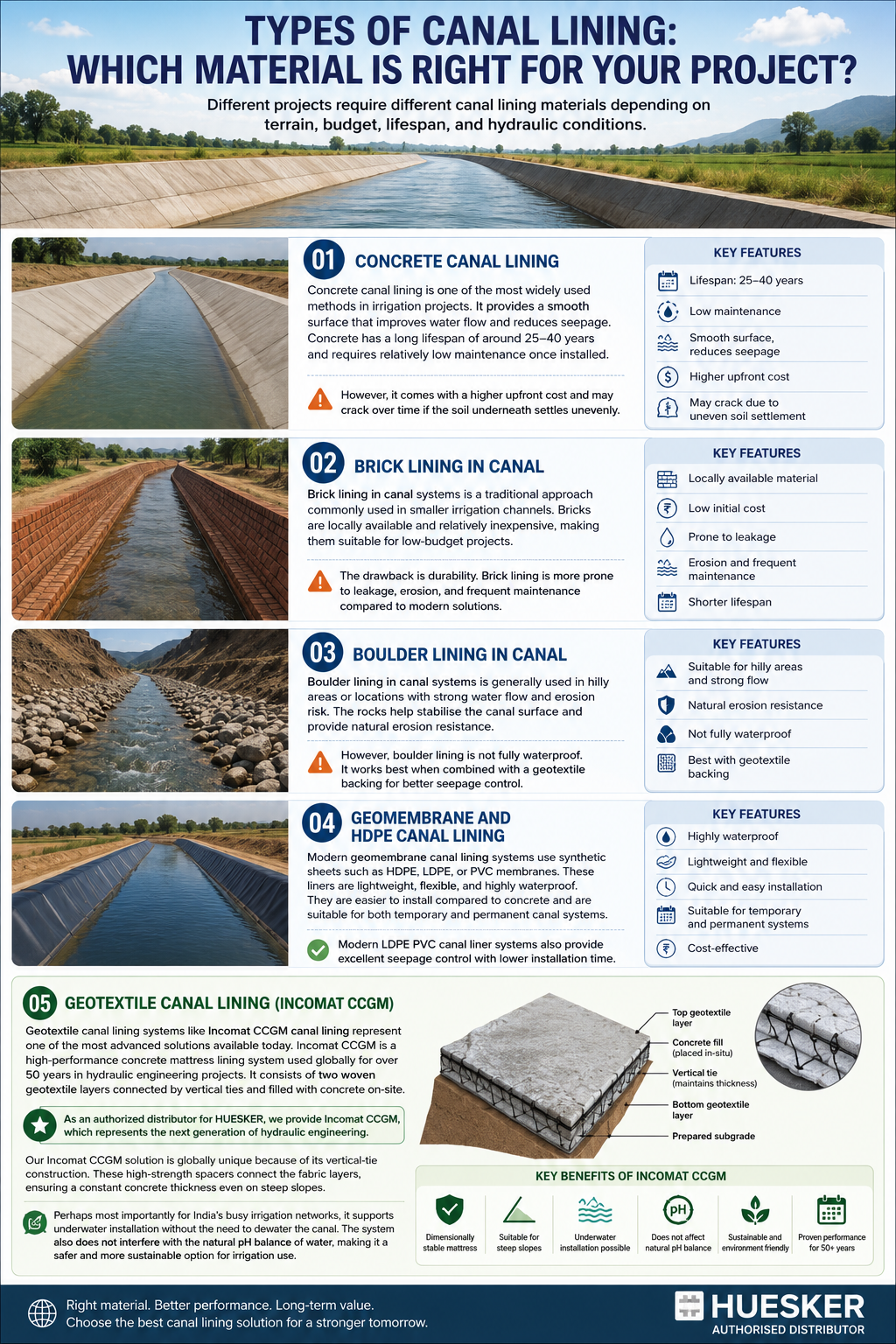
Types of canal lining: which material is right for your project?
Different projects require different canal lining materials depending on terrain, budget, lifespan, and hydraulic conditions.
1. Concrete canal lining
Concrete canal lining is one of the most widely used methods in irrigation projects. It provides a smooth surface that improves water flow and reduces seepage. Concrete has a long lifespan of around 25–40 years and requires relatively low maintenance once installed.
However, it comes with a higher upfront cost and may crack over time if the soil underneath settles unevenly.
2. Brick lining in canal
Brick lining in canal systems is a traditional approach commonly used in smaller irrigation channels. Bricks are locally available and relatively inexpensive, making them suitable for low-budget projects.
The drawback is durability. Brick lining is more prone to leakage, erosion, and frequent maintenance compared to modern solutions.
3. Boulder lining in canal
Boulder lining in canal systems is generally used in hilly areas or locations with strong water flow and erosion risk. The rocks help stabilise the canal surface and provide natural erosion resistance. However, boulder lining is not fully waterproof. It works best when combined with a geotextile backing for better seepage control.
4. Geomembrane and HDPE canal lining
Modern geomembrane canal lining systems use synthetic sheets such as HDPE canal lining, LDPE, or PVC membranes. These liners are lightweight, flexible, and highly waterproof.
They are easier to install compared to concrete and are suitable for both temporary and permanent canal systems. Modern LDPE PVC canal liner systems also provide excellent seepage control with lower installation time.
5. Geotextile canal lining (Incomat CCGM)
Geotextile canal lining systems like Incomat CCGM canal lining represent one of the most advanced solutions available today. Incomat CCGM is a high-performance concrete mattress lining system used globally for over 50 years in hydraulic engineering projects. It consists of two woven geotextile layers connected by vertical ties and filled with concrete on-site.
As an authorized distributor for HUESKER, we provide Incomat CCGM, which represents the next generation of hydraulic engineering. This system consists of two geotextile layers that are filled with concrete in-situ, creating a dimensionally stable mattress.
Our Incomat CCGM solution is globally unique because of its vertical-tie construction. These high-strength spacers connect the fabric layers, ensuring a constant concrete thickness even on steep slopes. Perhaps most importantly for India’s busy irrigation networks, it supports underwater installation without the need to dewater the canal. The system also does not interfere with the natural pH balance of water, making it a safer and more sustainable option for irrigation use.
Comparison of canal lining solutions
| Lining Type | Lifespan | Seepage Reduction | Maintenance Cost | Best For |
| Concrete | 25-40 years | High | Medium | Main Canals |
| Brick/Boulder | 10-15 years | Medium | High | Field Channels |
| HDPE/PVC | 15-25 years | Very High | Low | Water-Stressed Zones |
| Incomat CCGM | 50+ years | Very High | Extremely Low | Rehabilitation & Slopes |
Lined vs unlined canals: what’s the difference?
The difference between lined and unlined systems is the difference between a leaky bucket and a sealed pipe. Unlined canals are porous by nature, allowing water to bleed into the earth at every meter. Lined canals create an impermeable barrier that ensures the water you release at the head of the canal is the same amount that reaches the farmers at the tail end.
Flow speed also changes significantly. Lined canals have lower hydraulic roughness, which increases conveyance velocity. This means water reaches distant fields faster, which is critical during peak irrigation seasons. Finally, there is the issue of soil health. While unlined canals contribute to waterlogging that can kill crops, lined canals keep the water where it belongs, preserving the integrity of the surrounding agricultural land.
What makes a canal lining durable? Key factors to consider
A durable canal lining solution in India must withstand extreme temperatures and varied soil conditions. Several technical factors determine the ultimate service life of a lining system:
- Material quality and thickness: The inherent strength and gauge of the liner dictate its resistance to punctures and abrasion.
- Soil type and terrain conditions: Expansive soils can cause rigid linings to crack, while steep slopes require materials that maintain their profile without slipping.
- Flow velocity and hydraulic load: High-speed water flow exerts significant pressure on the lining, requiring a system with low hydraulic roughness and high dimensional stability.
- UV resistance of the material: In the intense Indian summer, materials must be stabilized against UV degradation to prevent brittleness and failure.
- Quality of installation: Even the best material will fail if joints are not sealed properly or if the base preparation is inadequate.
Advanced solutions like Incomat CCGM address all five of these factors. Its unique vertical-tie construction ensures that the concrete mattress remains perfectly uniform even on uneven surfaces, while its high-tenacity fabric provides built-in UV resistance and a 50 plus year service life. For projects requiring both canal bank erosion protection and long-term durability, Incomat CCGM is the superior choice.
Canal lining rehabilitation: restoring India’s ageing irrigation infrastructure
Much of India’s irrigation infrastructure is decades old, with many canals experiencing structural deterioration and massive seepage through cracks in original concrete or masonry. Rehabilitating these aging networks is a top priority for government agencies under the Jal Shakti mission.
Modern geotextile solutions like Incomat CCGM provide a revolutionary approach to rehabilitation. Instead of costly and time-consuming demolition of old canal beds, these mattresses can be laid directly over the existing damaged surface. This retrofitting method significantly reduces project costs and installation time while meeting the latest Central Water Commission guidelines and PMKSY requirements for canal modernization. By restoring these lifelines, we can recover lost water resources without disrupting local agricultural cycles.
Choosing the right canal lining solution for India
In 2026, the right canal lining choice depends on a balance of terrain, budget, and lifespan requirements. While traditional methods have their place in small-scale field channels, large-scale national infrastructure projects increasingly require the superior durability and water conservation offered by modern geotextiles and geomembranes.
Partnering with an authorized distributor like Signet Enertech ensures that your project utilizes the most advanced research on reinforced composite concrete and global engineering best practices. We focus on delivering sustainable irrigation solutions that solve India’s water management challenges for the long term.
Signet Enertech, authorised Indian distributor of Incomat CCGM by HUESKER, offers expert consultation for canal lining projects across India. Contact us to find the right solution for your project.
Contact Signet Enertech today to discuss how our advanced canal lining and erosion control solutions can benefit your next project.