
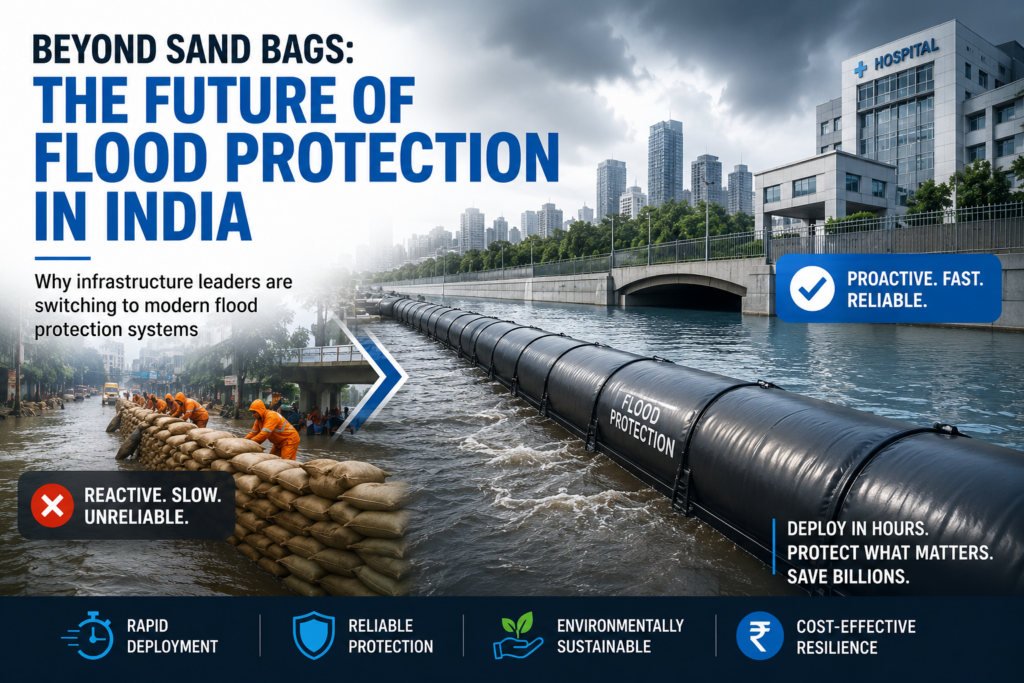
Every monsoon season, India loses billions in flood damage; traditional methods are failing. Here’s how modern flood protection systems actually work and why infrastructure decision-makers are switching to them.
India lost over INR 4.69 trillion to floods in the last 65 years, yet despite spending INR 13,000 crores on flood mitigation since 2007, damage has not decreased because traditional sandbags and embankments fail when intensity spikes. Modern flood protection systems solve this by shifting from reactive defense to proactive barriers that deploy in hours, not weeks, and protect critical infrastructure without permanent construction.
The monsoon season has become a predictable crisis. Every year, water overwhelms the same underpasses, inundates the same hospitals, and shuts down the same critical infrastructure. Not because the water is unexpected, but because the defenses we’ve built don’t scale to reality. Let’s look at why traditional methods keep failing, and what actually works instead.
Why India’s flood crisis is escalating
The numbers tell the story. India has lost over INR 4.69 trillion to floods in the last 65 years, even after spending INR 13,000 crores on flood mitigation since 2007. The investment hasn’t reduced damage because the approach hasn’t changed. It’s like trying to hold back a tide with older and older walls.
Recent events underscore how dire this is. In September 2025, the Yamuna in Delhi breached 207 meters, and 560,000 sandbags were deployed to protect critical infrastructure, yet flooding still penetrated key areas. In Mumbai, 59 new flood-prone zones have been identified in just the last two years. Coastal areas, river basins, industrial zones, underground metro stations, and basement parking across major cities are no longer occasional flood risks, they’re routine ones.
The root cause is structural. India’s annual water flows are concentrated: 75% of the country’s water flows in just 4 months between June and September. Meanwhile, drainage systems designed 30-50 years ago can’t handle current volumes. Urban sprawl has replaced open land with concrete, removing natural water absorption. Blocked waterways force water onto roads. Climate variability has made monsoon patterns unpredictable and more intense. The infrastructure was built for a different flood regime entirely.
Why traditional flood protection methods are failing
Sandbags are the visible symbol of this failure. Filling them is manual, slow, and labor-intensive. During the Delhi flooding, 560,000 bags were deployed manually, and water still breached critical facilities. The process takes hours per location and requires teams of workers. It’s reactive by design: water rises, then you scramble to build barriers. By that time, water is already entering underpasses and basements.
Embankments and levees seem like permanent solutions until they fail. The real problem is psychological: they create what researchers call the “levee effect.” When people believe they’re protected by a permanent barrier, they build more in floodplains, increasing vulnerability. Investments concentrate in areas that feel safe but aren’t. More importantly, traditional structures fail during extreme events because they’re designed for normal rainfall, not the intensity spikes we now see. Build a wall for a 1-in-10-year flood, and a 1-in-25-year event overwhelms it.
Even concrete barriers and walls share the same flaw: they’re permanent, expensive, and slow to build. Construction disrupts urban areas for weeks or months. Once built, they’re inflexible. If the flood risk changes or your infrastructure needs expand, you’re stuck with what you have. The paradigm is fundamentally reactive. Traditional approaches say, “Let’s prevent water from flowing where it shouldn’t.” Modern approaches ask a different question: “What if we stopped trying to control water and instead protected what matters?”
Modern flood protection systems: an overview
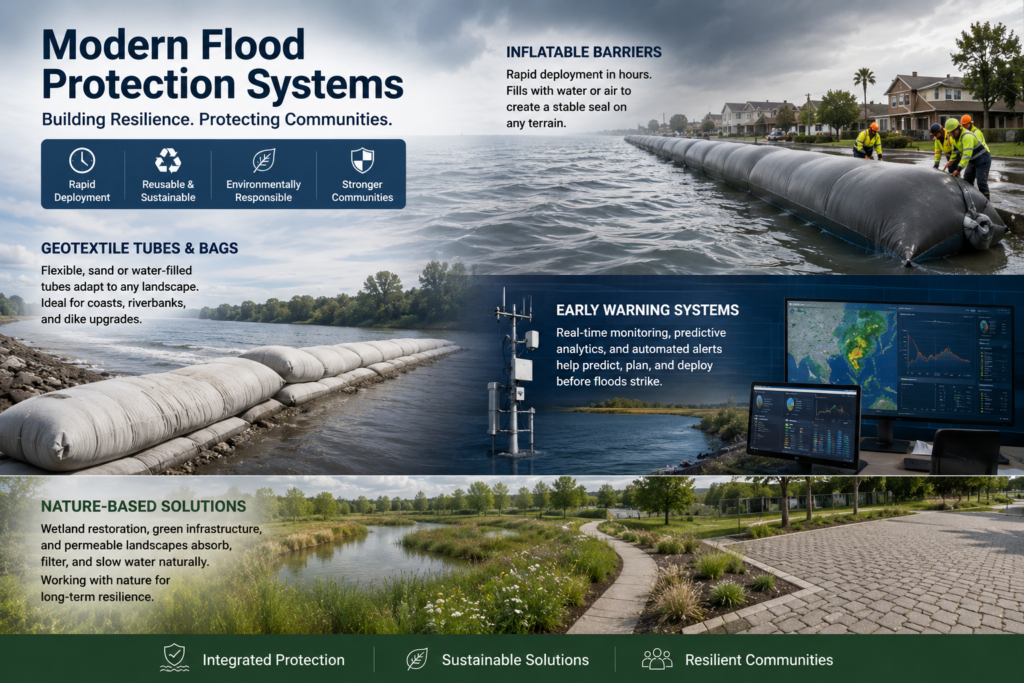
The shift is from prevention to resilience. Inflatable barriers deploy from stored, compact material in hours. They fill with water or air, creating a stable seal even on uneven ground. Once the flood passes, you deflate them, clean them, and store them again. No permanent footprint, no construction waste, no long-term environmental impact.
Geotextile tubes and bags are another solution. These are flexible fabric tubes filled with sand or water, conforming to any landscape. They work for coastal protection, riverbank reinforcement, and dike upgrades. They cost less and install faster than traditional stone revetments, and they’re environmentally sustainable because they can be reused and adjusted as terrain changes.
Flood early warning systems use real-time monitoring and predictive analytics. Sensors detect rising water levels, satellite data forecasts rainfall, and automated systems trigger barrier deployment days in advance. This shifts the entire model from “react when flooding starts” to “predict, plan, and deploy before water arrives.” Preparation always costs less than repair.
Nature-based approaches, like wetland restoration and green infrastructure, work alongside engineered systems. Bioswales, permeable pavements, and restored wetlands reduce the pressure on barriers by naturally absorbing and filtering water. The best solutions combine engineered barriers with environmental recovery.
How inflatable flood barriers work: the practical advantage
The deployment speed is the breakthrough. A team of four people can install 1,000 meters of barrier in under 4 hours. Think about that: a distance that would take weeks of construction with traditional walls, completed by a small team in a morning shift. The barrier is stored in compact rolls or pouches, transported easily, and deployed where needed at the moment it’s needed.
The installation process is straightforward. You position the barrier material where protection is needed, connect it to a water or air source, and activate. The barrier fills and creates a watertight seal even on uneven ground, paved surfaces, or wet terrain. Because it’s water-filled, it’s stable without anchoring to the ground. No excavation, no foundation work, no permanent construction permits needed.
The real cost advantage emerges over time. A barrier can be deployed and removed multiple times, season after season, or year after year. A sandbag is used once and discarded. A permanent wall costs a fortune to build and can never be removed if circumstances change. An inflatable barrier amortizes its cost across decades of use.
SIGNET ENERTECH produces three variants to match different needs. The PRO version is designed for large-scale infrastructure protection, roads, and major underpasses where durability and long deployment lengths are critical. The FLEX variant prioritizes quick deployment for emergency response and variable terrain, where adaptability matters more than maximum scale. The ALU version deploys without needing a water source, using self-contained pressurization, which is essential in areas where water access is limited or unreliable. All three reduce carbon emissions dramatically: 99.5% less CO2 per kilometer compared to sandbag deployment, simply because there’s no manual filling, no transportation of tons of sand, and no waste disposal.
Real-world applications span roads, underpasses, metro entrances, basement parking, commercial districts, and industrial zones. Any location where temporary water protection prevents major losses is a candidate.
Geotextile solutions for coastal and riverbank protection
Geotextile tubes are flexible fabric tubes filled with sand or water, conforming to the landscape rather than fighting it. They’re deployed along coastlines, river margins, and in dike upgrades. They work because they move with the terrain instead of imposing a rigid structure on it.
The advantage over traditional stone revetments is both practical and environmental. Installation is faster and costs less, without the heavy machinery and material waste of traditional approaches. The fabric can be reused or recovered, reducing long-term costs. And geotextiles adapt as terrain changes, shifting with erosion rather than cracking under pressure.
In India, geotextile solutions are deployed across coastal cities like Mumbai and Chennai, and along major river basins including the Ganga, Brahmaputra, and Godavari. They can be configured as temporary protection during monsoon season or left in place permanently, depending on needs. They’re proven technology with decades of track record in flood-prone regions.
Key infrastructure sectors needing flood protection
Different sectors have different vulnerabilities. Roads and bridges face flooding in underpasses and low-lying junctions during heavy rainfall. Water-Gate barriers deployed at these points keep transport links operational during the monsoon, preventing the cascading disruption of commerce and emergency response.
Industrial facilities and power plants are often located in flood-prone areas because they need river access. Warehouse gates, chemical storage areas, equipment rooms, and electrical substations are critical to business continuity and safety. These are high-consequence failures: a flooded warehouse means inventory loss, a flooded generator room means no power, a flooded chemical storage area is an environmental and safety disaster.
Urban infrastructure including hospitals, government buildings, and shopping malls can’t afford downtime. Hospital emergency room entrances, generator rooms, and pharmacy storage must stay dry. Shopping mall basements and parking garages flood regularly in major cities. Government facilities need continuous operation. Recent flooding in Delhi and Mumbai affected exactly these sectors, and the recovery costs were enormous.
Residential areas and utilities face compound risks. Compound gates, lift shafts, and water pump rooms are critical to housing societies. Urban drainage and stormwater systems must handle monsoon runoff without backing up into buildings. Public housing and rehabilitation areas often sit in flood-prone low-lying zones.
Choosing the right flood protection system for your needs
The decision comes down to five factors. First, scale of protection: are you protecting a single building entrance or a kilometer-long highway? Second, deployment speed: do you need emergency response within hours, or can you plan weeks in advance? Third, permanence versus flexibility: do you need a permanent installation or reusable temporary barriers? Fourth, budget: do you have capital for large upfront infrastructure or do you prefer per-deployment costs? Fifth, terrain: is your location smooth embankment, uneven urban pavement, or coastal inlet?
Small-scale, frequent risks like urban underpasses and basement entries benefit from inflatable barriers or demountable gates. Large-scale coastal or riverine protection is better served by geotextile tubes, permanent storm surge barriers, or hybrid systems combining nature-based and engineered approaches. Industrial facilities need water-gate systems and modular barriers that protect high-consequence assets. Emergency rapid response requires portable self-expanding flood bags combined with barrier systems. Long-term infrastructure resilience comes from layered approaches: nature-based solutions reducing pressure on barriers, combined with engineered systems for extreme events.
The key principle is simple: choosing the right system starts with understanding your flood risk (frequency, intensity, location, critical assets), then matching that to a solution that balances speed, cost, reusability, and environmental impact.
Protecting India’s infrastructure before the next monsoon
Traditional methods have had 65 years and INR 4.69 trillion of losses to prove their approach doesn’t work. Yet they remain the default because the alternatives weren’t understood or accessible. Modern flood protection systems shift from reactive response to proactive defense, from permanent construction to flexible resilience, from environmental damage to sustainability.
The advantages compound. Speed means you deploy when you need protection, not months before. Flexibility means you can adjust as flood patterns change. Cost-effectiveness means protection doesn’t require massive government budgets or long approval processes. Sustainability means you’re not sacrificing the environment to defend against environmental events. Resilience means your critical infrastructure stays operational instead of requiring disaster recovery.
For infrastructure managers and city planners, the path forward is clear. Assess your flood risk: historical frequency, intensity, vulnerable assets, monsoon patterns in your region. Match that risk to the right solution. Consider inflatable barriers for quick deployment, geotextile solutions for coastal and riverine permanent protection, hybrid approaches for comprehensive resilience. Plan for both seasonal flooding and extreme scenarios.
SIGNET ENERTECH provides engineered flood protection systems designed specifically for India’s infrastructure challenges. From rapid-deployment No-Flood Barriers in PRO, FLEX, and ALU variants, to geotextile solutions for coastal protection, the company offers practical, proven alternatives to sandbags and embankments. Protect your infrastructure before the next monsoon arrives. The cost of preparation is always less than the cost of repair.